.png)
MARCH NEWSLETTER:
- Alpha & Omega Oil

- Mar 10
- 5 min read
A New Perspective: Same Rich History  Dear Friends,
Something beautiful has been unfolding on our land. After a year of tending, restoring, and reawakening, our ancient olive grove is slowly coming back to life. What began as a quiet dream is now a living, breathing world—renewed, nurtured, and ready to share its gifts with you.
-Megan  |
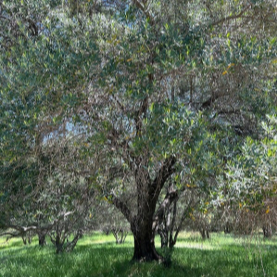
For years we’ve had a piece of artwork hanging in our bedroom that reads, “For I know the plans I have for you… plans to give you hope and a future” — Jeremiah 29:11. Olive branches frame the verse, and I never realized that all this time, God was quietly showing us a glimpse of the future He was preparing for us. My husband and I spent years searching for a place that truly felt like ours. We walked through dozens of open houses—some we liked, a few we loved—but nothing settled in our spirit the way this land did. The house itself needed more work than we imagined, and the year that followed stretched us in ways we didn’t expect. But this home offered something no other could: a legacy. The old olive orchard surrounding the home called out to me. Standing beneath those trees felt like stepping outside of time itself. The world grew quiet, as if the branches were absorbing every worry, every doubt, every fear. All the anxiety and planning we carried seemed to fall away in their presence. Eventually, it didn’t even matter whether there was a house on the land at all—I wanted to be near those ancient olive trees. There’s an old story about The Crying Tree. Believing that trees carried spiritual weight, Indigenous people found comfort in choosing a single tree to sit beneath in times of stress or mourning. They would rest a hand on its cool bark and whisper their troubles, trusting the tree to draw their sorrow down into its deep, steady roots. It was said the tree listened without judgment, always present when worries grew too heavy to hold alone. I believe God wove that harmony into creation itself—every person, every plant, every living thing connected with purpose. Nature isn’t random or lifeless; it’s a gift, a living testament to God’s abundant love and care for us. The morning that we decided to place an offer on the olive grove, I asked God to show me that this was His plan for our lives. A simple word, a small sign. I opened a book I had not read for years, and immediately my eyes widen, and my heart leapt. It was the story of the widow in the Bible whose sons were about to be taken as payment for her debt. In desperation, she went to the prophet Elisha and asked what she should do. He told her to gather as many empty jars as she could from her neighbors, take them into her house, shut the door behind her, and begin pouring the little olive oil she had into them. So she did exactly as he said—she collected every jar she could find, went inside with her sons, and began to pour. Miraculously, the olive oil kept flowing until every jar was filled. With that olive oil, she paid off her debts and saved her sons, and the rest became her provision. Not 10 minutes after praying did God give me this story. I had never heard it before and was overwhelmed at his precision and response. I rushed to tell my husband, "This is our home". Even when the closing process and negotiations dragged on for months, I held this promise in my heart. Because I asked, and God answered. And He is a promise-keeper. "This is our home." And after many months, we finally moved in. |
 |
Our first harvest was done by hand—one olive at a time. I spent an entire day gathering what I could, proudly filling a small basket. As I walked through the orchard, I kept wondering if any of my ancestors had done this very thing. There was something familiar about it. As I was plucking olives, while my children ran beneath the branches, my heart swelled with love and awe for such a simple, ancient task.
I’m drawn to learning through the earliest methods, the way it all started. So I crushed those olives with a mortar and pestle, quickly learning just how dramatic they become when they pop (goggles highly recommended). I then pressed them in a small hand-crank counter press. After many cheesecloths, spills, and a heroic amount of mess, I finally had liquid… which I soon discovered was mostly olive juice. I tucked it away, disappointed but not defeated.
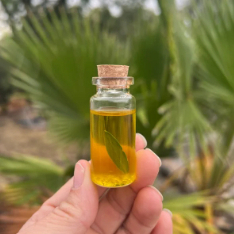
About two weeks later, a tiny layer of oil had risen to the top—maybe three drops of precious gold. A mere 336 hours of labor and waiting!
But that was the only the beginning. I kept adjusting, experimenting, and following every door the olives opened. And they opened more than we ever expected. |
 |
Shortly after several marathons of extensive manual labor, a neighbor generously offered to lend us a larger olive press, one that would no longer fit on my counter. Into the garage we would go! It felt like a major upgrade. We were ecstatic, with dreams of gallons of olive oil flowing soon. Oh, how silly that sounds looking back. But we knew that no matter how much we got, we had to learn the fruit. How they behaved, reacted, and what worked best. It was a mix of curiosity and reverence for the process that pushed us to continually learn and experiment. |
 |
This next process was difficult for us. It produced a little more oil, yes, but the work was intensive, and the mess exponential. You see, olives must be pressed within about 24 hours after harvesting in order to protect the olives from quickly degrading. So we would spend all day, upgrading from hand-plucking to garden rakes and brooms, getting what we could. Some parts of the process were much more efficient, like using the equivalent of a food processor into a bucket instead of my rock-banging techniques of old. After transforming the olives to a beautiful purple pulp, we put them in a bucket with an ice-cream mixer device for 45 minutes to further separate the oil. Finally, after a few hours (and usually after dark by now), we put them into the press. First goes cheesecloth (not recommended), a plop of purple pulp, and another cheesecloth. Repeat ten times. When the pulp pressed down, the juice and olive oil flows. It drained into yet another bucket. Not surprisingly, we had a lot more juice than oil. After days of this, we walked away with about a cup of olive oil. We knew this was not sustainable, but we didn’t have any options left but to keep improving the process, like upgrading from cheesecloth to specialized olive pressing fabric. That’s when the second door opened. |
 |
Behind door number two was a family-friend who had been following our journey. In an incredible act of kindness and generosity, she donated us not one but two French olive rakes (made specifically for efficiently and gently removing olives). With our new battery-pack olive extractors, we planned one more late-season harvest. In one day we went from 1 small bucket of hand-picked olives, to 425lbs of fruit. We couldn’t believe it! We had them professionally milled with state-of-the-art cold press extraction. As we finished the season, we had 6 jugs of oil, and a lot more ideas. This is the moment the rest of our dreams begin to take shape. |




Comments